 by
by A Rare Blend of Science and Beauty
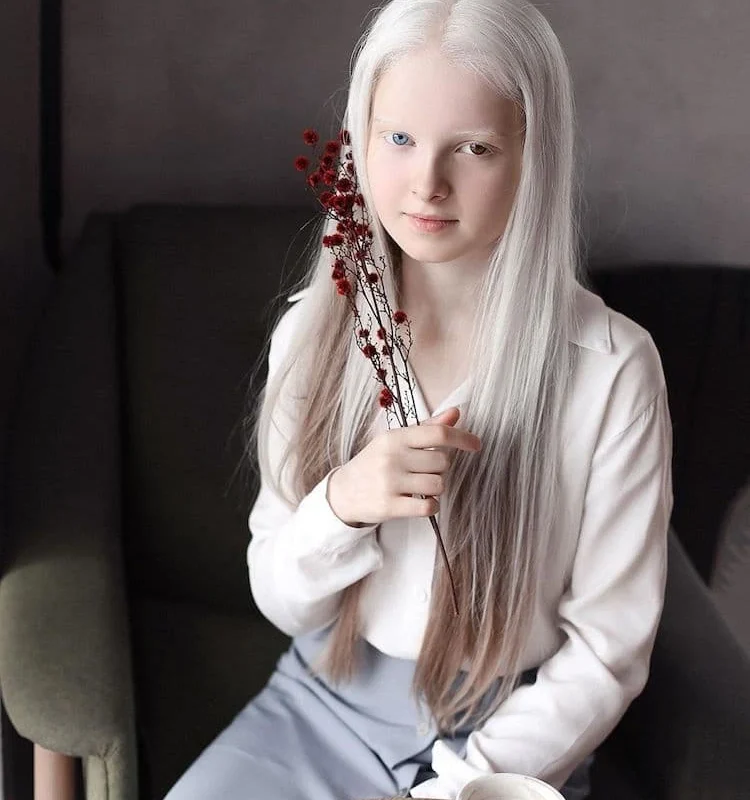
At just eleven years old, Amina Ependieva from Chechnya has captured international attention with her striking features. Born with two uncommon genetic traits — Albinism and Heterochromia iridum — her pale complexion and two differently coloured eyes aren’t the effect of photo editing or filters, but the remarkable result of human genetics. Her portraits, taken by photographer Amina Arsakova, went viral and shine a spotlight on how diversity can define natural beauty. (My Modern Met)
Albinism involves a reduced production of melanin — the pigment responsible for skin, hair and eye colour. (nhs.uk) Meanwhile, heterochromia leads to one eye being a different colour from the other. (WebMD) Together, these traits contribute to Amina’s exceptional and memorable appearance.
Understanding Albinism and Heterochromia
Albinism: This is an inherited condition where the body produces little or no melanin pigment, which affects skin, hair and eyes. According to the NHS, people with albinism often have very light hair and skin, and may face vision-related issues. (nhs.uk) The Cleveland Clinic explains that albinism affects optic nerve development as well, meaning those with the condition may experience blurred vision or light sensitivity. (Cleveland Clinic)

Heterochromia iridum: This occurs when a person has two differently coloured irises, or when a single iris contains more than one colour. It’s typically harmless. According to WebMD, there are several types of heterochromia and it can arise congenitally (from birth) or later in life. (WebMD)
In Amina’s case, her combination of albinism (leading to pale skin and hair) and heterochromia (two eye colours) is exceedingly rare. Some sources suggest the possibility of a syndrome like Waardenburg being involved, but no definitive public medical confirmation exists. (MRU.INK)
Amina’s Story: A Symbol of Diversity and Beauty
Amina’s rise to recognition began when photographer Amina Arsakova discovered her image in a shopping centre and was instantly drawn to her unique look. (My Modern Met) The resulting portraits emphasize gentleness, calm and natural beauty, and quickly spread across social media and photo blogs.
Her story is significant beyond one individual: it reminds us that visible differences can be powerful expressions of human variety — not flaws to hide. On platforms like ViralSensei we explore how beauty standards are evolving and how inclusion in modelling and media matters. For example, identity and representation in modelling continue to shift as diverse features become celebrated rather than hidden.
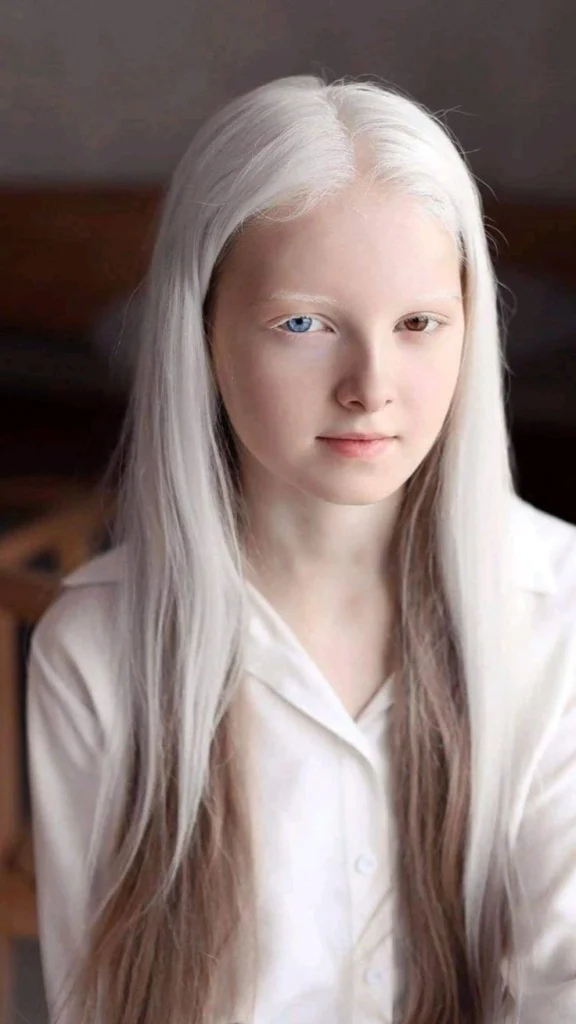
By embracing her distinct appearance, Amina serves as an emblem of individuality and acceptance — an important message in a world where ‘standard’ beauty has long excluded those who look different.
The Broader Message: Celebrating Individuality
When we look at Amina’s story, the takeaway isn’t solely about her appearance — it’s about how we define beauty. The combination of her pale skin, light hair and two coloured eyes challenges traditional beauty norms and shows that what makes someone different can also make them extraordinary.
For those interested in deeper scientific reading, the Mayo Clinic offers authoritative information on albinism — its causes, diagnosis and management. (Mayo Clinic) Also, the NHS resource library provides useful insight into how albinism affects vision and day-to-day life. (Sheffield Children’s NHS Library)
Within the broader conversation around modelling, marketing and media representation, her image supports the message that real beauty includes all colour variations, all body types and all kinds of genetic difference. You can explore more content on diversity in beauty and visible uniqueness on ViralSensei’s feature about representation in modelling (internal link) and our article on embracing visible differences as strength (internal link).
Ultimately, Amina teaches us that being different is not a liability — it is a reflection of nature’s creativity.
Key Takeaways
- Amina Ependieva is a young girl from Chechnya born with both albinism and heterochromia — a rare combination.
- Albinism is an inherited condition marked by low or absent melanin pigment; it affects skin, hair, eyes and sometimes vision.
- Heterochromia produces differently coloured irises; in her case, one brown eye and one blue eye.
- Her story has resonated globally, not just for aesthetics, but for the deeper message of embracing diversity.
- Celebrating unique appearances like Amina’s helps broaden what we understand as beauty and builds more inclusive standards.
Final thought: Beauty does not have a single definition — it exists in every shade, form and combination. Amina’s story invites us to honour individuality, challenge outdated norms and appreciate the remarkable variety of human appearance.
Featured Image Credit: (Mymodernnet,Pinterest)