 by
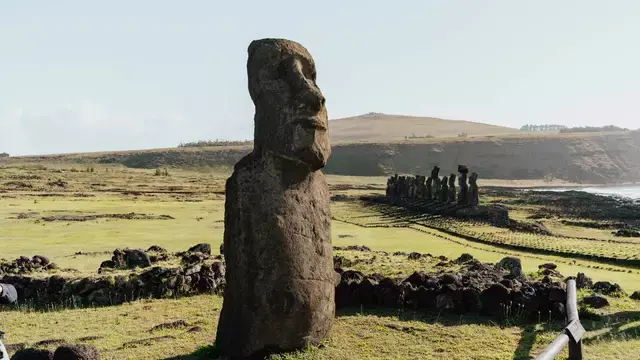
by When people talk about the world’s greatest mysteries, names like Stonehenge and the Egyptian pyramids often come up. But one of the most fascinating and lesser-known wonders lies in the middle of the Pacific Ocean — the massive Moai statues of Easter Island in Chile.
For centuries, these monumental figures have puzzled historians and archaeologists. How did the ancient Rapa Nui people move such colossal structures without modern tools or machines? Now, after years of research, scientists finally believe they’ve uncovered the secret — and it’s both simple and ingenious.
The Lasting Mystery of the Moai
Carved between 1250 and 1500 CE, the Moai statues were created by the Rapa Nui, the Polynesian inhabitants of Easter Island. Each statue stands several meters tall and weighs between 12 and 14 tons, with some exceeding 80 tons.
At first glance, they seem like giant stone heads rising from the earth. But most of the statues actually have full bodies buried beneath layers of soil, revealed through archaeological digs.
The challenge that baffled researchers for generations was how these massive figures were transported across the island’s rocky, volcanic landscape.
To explore more about lost civilizations and ancient cultures, visit the History & Culture section on Viral Sensei.
A Breakthrough Discovery
A major breakthrough came from Professor Carl Lipo of Binghamton University and Professor Terry Hunt of the University of Arizona, whose work has redefined how we understand the Moai’s movement.
Their findings, published in The Journal of Archaeological Science, suggest that the statues were “walked” upright using a system of ropes and coordinated motion — not dragged flat on the ground, as once believed.
This theory aligns with the oral traditions of the Rapa Nui, who said the statues “walked with mana,” a kind of spiritual power.
As explained in a detailed analysis by Smithsonian Magazine, the ancient story may have preserved an accurate memory of how the statues were actually moved.
Recreating Ancient Engineering
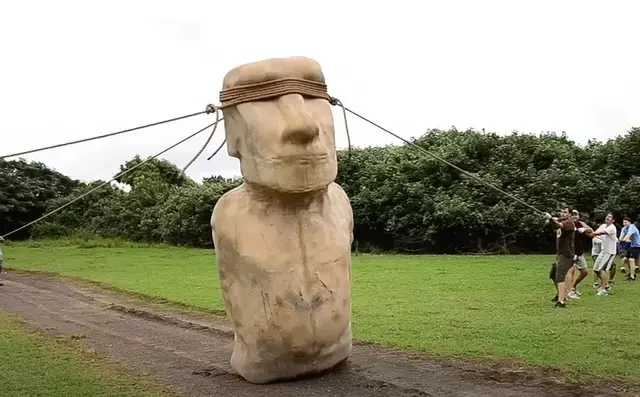
To test their hypothesis, Lipo and Hunt built a 4.35-ton replica Moai and attempted to move it using just 18 people and a few strong ropes.
The results were stunning: the statue walked upright for 100 meters in 40 minutes, rocking gently from side to side with each pull.
Once the motion began, it became surprisingly easy to control.
“Once you get it moving, it isn’t hard at all — people are pulling with one arm. It conserves energy, and it moves really quickly,” Lipo told reporters during the demonstration.
National Geographic documented the experiment in its coverage of Easter Island’s engineering marvels, which you can read here.
For more stories about ancient discoveries and human ingenuity, visit the Science & Discovery section on Viral Sensei.
How Physics Played a Role
The Moai’s unique design made all the difference. With slightly rounded bases and forward-leaning centers of gravity, they were naturally balanced for controlled rocking.
As statues grew larger, this “walking” motion became even more effective.
Researchers believe the Rapa Nui carved the statues specifically to be moved upright — a sophisticated understanding of weight distribution and stability that shows how advanced their engineering truly was.
According to a report from BBC Science Focus, this design made dragging unnecessary and allowed people to transport the Moai over long distances with minimal effort.
Roads That Tell the Story
The discovery of ancient road networks across Easter Island offers even more evidence supporting the “walking” theory.
These paths are smooth, slightly concave, and often overlap — suggesting that the Rapa Nui carefully cleared and reused them to move the statues in stages.
“We actually see them overlapping each other and many parallel versions,” said Lipo. “They’re spending a lot of time on the road part.”
A detailed report from ScienceDaily confirms that these roads were purpose-built for statue transportation, showcasing how organized and resourceful this island civilization was.
You can find more insights on ancient engineering and culture in the Culture section of Viral Sensei.
Where Faith Meets Science
What makes this discovery especially fascinating is how it bridges science and spirituality.
The Rapa Nui belief that their statues “walked” has now found its scientific explanation: the walking motion wasn’t magical but mechanical — a perfect blend of teamwork, rhythm, and physics.
As detailed by Smithsonian Magazine, this connection between cultural legend and engineering innovation highlights how ancient societies encoded practical knowledge in spiritual traditions.
A Challenge to the Skeptics
The researchers stand firmly by their conclusions.
“Find some evidence that shows it couldn’t be walking,” Lipo challenged skeptics. “Because nothing we’ve seen anywhere disproves that.”
Their work has redefined what’s possible with limited tools, proving that ingenuity and cooperation can achieve what once seemed impossible.
It’s a story that celebrates the brilliance of human creativity — from the Rapa Nui of the past to scientists today who still learn from them.
Learn more about groundbreaking archaeological discoveries in the Discovery Hub on Viral Sensei.
A Lasting Symbol of Human Ingenuity
Today, the Moai still stand watch over Easter Island, facing the sea — silent, steadfast reminders of a civilization that mastered both engineering and imagination.
The mystery of how they moved may now be solved, but the wonder they inspire continues.
As ScienceDirect notes in its analysis, these statues represent not just physical strength, but human collaboration — proof that even the heaviest stones can move when guided by purpose.
Reliable Sources
- ScienceDirect – Transport of the Easter Island Statues
- Smithsonian Magazine – How Easter Island’s Statues “Walked”
- National Geographic – How the Moai Moved
- BBC Science Focus – How the Statues Walked
- ScienceDaily – Moai Movement Discovery
Featured Image Credit: Fabien Pallueau/NurPhoto via Getty Images